

When Should Baby Start Solid Food?
I was so excited to start solid foods with my first baby. With ingredients from our community-supported agriculture delivery, I made her baby food with love. I ordered special spoons (to help with her ergonomics) and bowls, plates, cups and storage containers.
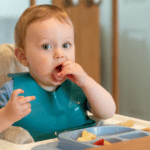
And then guess what? She hated pureed food. Finally I tried giving her whole, soft foods she could pick up herself. She loved food! Once she could feed herself with a spoon, she also loved the special pureed food I’d make (more on both of those ideas at the end of the blog.)
As your baby grows from newborn to infant, you may wonder: when should she start solid food? The simplest answer is around six months old, when she is showing signs that she is developmentally ready.
There’s nothing magical about the day your baby turns six months old! Babies develop at slightly different rates, so instead of watching the calendar alone, look for signs that your baby is ready to start exploring food.
Some signs of readiness include:
- She can sit upright with good head and neck control. She doesn’t necessarily need to sit completely independently, but she should be able to sit upright in a high chair or feeding seat with little or appropriate support.
- She can swallow food instead of automatically pushing it back out with her tongue. Young babies have a tongue-thrust reflex that gradually decreases as they become ready for solid foods.
- She is around six months old. The American Academy of Pediatrics and CDC recommend introducing foods other than breast milk or formula at about six months of age.
- She brings things to her mouth and tries to grasp objects or food. These are signs that she’s developing the coordination she’ll use as she begins exploring food.
- She shows an interest in food. Maybe she’s watching you eat, reaching toward your plate or opening her mouth when food is offered.
Why delay solid foods until your baby is ready?
First, we want to make sure that she gets all of the wonderful nutrition of breastmilk prior to six months. Also, these signs above show us that your baby’s digestive system is mature enough to handle solid foods AND that your baby is developmentally ready to participate in mealtime. Most babies are ready between six and eight months of age.
Okay, so your baby is ready. How should you get started with solid foods?
There isn’t one “right” way to introduce solid foods. Some families start with purées and spoon-feeding, some prefer baby-led weaning (or baby self-feeding), and plenty of families do a combination of both.
Here are a few tips to make getting started a little easier:
Start small. In the beginning, eating solid food is mostly about learning and exploring. Start with small amounts when your baby is awake, comfortable and not overly hungry or tired. Breast milk or formula will continue to be an important source of nutrition as your baby learns to eat.
Offer a variety of tastes and textures. You don’t have to stick with perfectly smooth purées. As your baby’s eating skills develop, you can offer mashed foods, thicker textures and soft finger foods prepared in a way that is appropriate for her age and development.
Let your baby participate. Babies learn a lot by touching, squishing, smelling and attempting to feed themselves. Yes, this can get messy. Very messy. But exploring food is part of learning how to eat.
Include iron-rich foods. Around six months, iron becomes an especially important nutrient. Meat, beans, lentils, eggs and iron-fortified infant cereals are some options you can offer along with fruits and vegetables.
Don’t delay common allergens. Once your baby is ready for solid foods, common allergens such as peanut and well-cooked egg can be introduced in safe, age-appropriate forms. For example, smooth peanut butter can be thinned or mixed into another food your baby has already eaten. Never give a baby whole peanuts or a spoonful of thick peanut butter, as these are choking hazards. If your baby has severe eczema, an egg allergy or another known food allergy, talk with your pediatrician about when and how to introduce peanut and other allergenic foods.
Know the difference between gagging and choking. Gagging can be a normal part of learning to eat, but choking is an emergency. Always have your baby sitting upright and supervised while eating, prepare foods appropriately for her developmental stage, and avoid choking hazards. And remember that babies under 12 months should not be given honey because of the risk of infant botulism.
Follow your baby’s cues. You offer the food, but your baby gets to decide whether and how much to eat. Try not to worry if she eats very little at first. Some days she may enthusiastically devour what you offer, and other days most of it may end up in her hair, on the high chair or on the dog.
Most importantly, try to enjoy it. Introducing food isn’t just about nutrition. It’s the beginning of your baby’s relationship with food and family mealtimes, and it can be a lot of fun to watch her discover what she likes.
If you’d like to learn more about different approaches to starting solids, Baby-Led Weaning is a helpful resource for families interested in self-feeding, while Super Baby Food includes lots of ideas and recipes for making baby food at home.
And one of my longtime favorites is My Child Won’t Eat! for a reassuring perspective on how children eat and how we, as parents, can stress a little less about it.
You might also be interested in these articles: Help My Baby is Teething and our Infant Feeding & Lactation Guide.
Our team is always available to provide support. Reach out any time!

Christie Rinder is the founder of Buddha Belly Doulas, Tampa Bay's original and largest doula agency. Supporting families since 2009, she's passionate about ensuring every family has the support they need during pregnancy, birth, and postpartum. She believes in helping women recognize their own inner wisdom, strength and power.
Having served as President of the Tampa Bay Birth Network for six years and 17 years serving families as a doula and agency owner, she has a reputation for leadership, dedication and compassion. A childbirth educator, certified lactation counselor as well as a certified doula, she makes a point of ensuring mothers and their partners understand all their birthing options and what to expect on their journey. > learn more about Christie


Enjoy our popular guides to all things pregnancy, birth, postpartum and baby.

Tampa Pregnancy Guide
Your pregnancy journey is uniquely yours. From first trimester essentials to birth prep and postpartum planning, we’ll walk you through...

Your Guide to Hiring a Doula
Hiring a doula can be a game-changer, but knowing where to start isn’t always easy. This guide walks you through...
Labor & Birth Preparation Guide
Birth looks different for every family, and thoughtful preparation makes all the difference. Learn the basics of creating a birth...

Postpartum Recovery Guide
The weeks after birth are transformative and often the least talked about. Learn about: the physical and emotional sides of...